Unplug to Create: Why Today's Most Inspired Artists Are Logging Off to Tune In
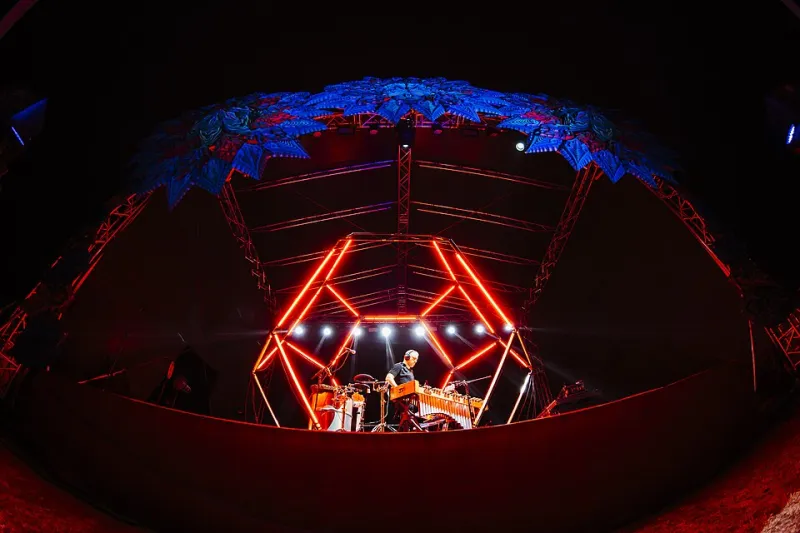
Photo: Alexboaca1, CC BY-SA 4.0, via Wikimedia Commons
There's a certain irony in the fact that the most powerful creative tool a musician or visual artist can pick up in 2024 might be the decision to put their phone down. In an era where visibility equals survival — where the algorithm rewards consistency, engagement, and an almost pathological need to be on — a growing number of creators are doing something that feels almost radical: they're choosing presence over performance.
And the work coming out of that choice? It hits different.
The Noise We've Normalized
Let's be honest about what the digital landscape actually looks like for a working creative. You wake up, check your streams, scroll through what everyone else is putting out, mentally compare your numbers, draft a caption for a post you haven't even finished yet, and then — somewhere in there — you're supposed to find the headspace to actually make something meaningful.
It's exhausting. And more importantly, it's creatively corrosive.
Producer and multi-instrumentalist Lena Vasquez, who's been quietly building a following out of her home studio in Portland, Oregon, described it bluntly in a recent conversation: "I realized I was making music for the thumbnail. Like, I'd be halfway through a track and already thinking about what the cover art would look like on Instagram. That's not how you make something that lasts."
She's not alone. Painters, photographers, beat-makers, and designers across the country are starting to name the same problem — that constant connectivity isn't just a distraction from the work, it's actively reshaping the work itself, often in ways that flatten it.
What 'Be Here Now' Actually Means for a Creator
The phrase has spiritual roots — Ram Dass made it iconic in 1971 — but in a creative context, it's less about enlightenment and more about a very practical shift in attention. Being here now, as a maker, means your process happens in real time, in the room, in the body, without one eye on the metrics.
For Chicago-based visual artist and muralist DeShawn Okafor, that shift came after a burnout spiral that left him staring at blank canvases for three months. "I had to completely detox from the idea that my art needed an audience before it was finished," he said. "I started painting with my phone in another room. No music streaming, no podcasts, just the work and whatever was in my head. The stuff I made in that period is the best I've ever done."
What DeShawn stumbled into is something researchers in creativity and cognitive science have been pointing to for years: deep, uninterrupted focus — what psychologist Mihaly Csikszentmihalyi famously called "flow" — is nearly impossible to access when your attention is fragmented by notifications, social comparison, and the low-grade anxiety of being perpetually reachable.
Flow isn't a luxury. For serious creative work, it's the whole ballgame.
Practical Disconnection: What Artists Are Actually Doing
So what does intentional disconnection look like in practice? It's not about going full hermit or swearing off social media forever. Most of the creators leaning into this philosophy are working with nuance — building structures that protect their creative time without completely abandoning the platforms that help them reach people.
Here are some of the strategies showing up repeatedly:
Scheduled creation windows. Singer-songwriter and producer Mara Jin, based out of Nashville, blocks the first three hours of her morning as a phone-free zone. No email, no socials, no streaming. Just her instruments, her journal, and whatever's brewing. "Those three hours produce more usable material than the rest of my day combined," she said.
Analog first drafts. A surprising number of digital artists and producers are going back to pen and paper, sketchbooks, and even cassette recorders for early-stage ideation. The friction of analog slows things down in a useful way — it forces commitment to an idea before you can endlessly tweak it.
Intentional listening. Rather than using music as background noise or algorithmic discovery fuel, some musicians are returning to active, focused listening — putting on a record, sitting with it, and actually paying attention. It sounds simple because it is, but it's become a genuinely countercultural act.
The "create before you consume" rule. This one's gaining serious traction. The idea is exactly what it sounds like: before you open any app, any feed, any inbox, you make something first. Even if it's just ten minutes of free writing or noodling on a guitar. You show up to your own creative mind before you let anyone else's voice in.
The Work That's Coming Out of It
What's notable isn't just that artists feel better when they disconnect — it's that the work is measurably more interesting. There's a texture and specificity to art made in genuine solitude that audiences can feel, even if they can't name it.
Mara Jin's most recent EP, recorded almost entirely during her phone-free mornings, has a cohesion and emotional directness that her earlier, more algorithm-chasing work lacked. DeShawn's "quiet period" paintings have been his most commercially successful, selling out a small gallery show in Wicker Park before the opening night was over.
There's something audiences are hungry for — something real, something that didn't get smoothed out in the process of being optimized for engagement. When a creator is fully present in their work, it shows.
Presence as a Creative Practice
Here's the thing: being present isn't passive. It's not about doing less. It's about doing the actual work with your whole attention, which is arguably harder than anything the algorithm asks of you.
The creators who are figuring this out aren't rejecting the modern creative landscape — they're navigating it on their own terms. They're using the tools without being used by them. They're showing up online strategically so they can disappear offline completely when it's time to make something.
That balance — between visibility and depth, between connection and solitude — might be the defining creative challenge of this moment. And the artists who crack it aren't just making better work. They're building something that lasts.
Mono Is Here because the work is here. The moment is here. And the best thing you can do for your art might just be to show up for it — fully, quietly, without your notifications on.
Got a practice you use to stay present while creating? Drop it in the comments — we want to hear how you're doing it.