Stop Documenting, Start Creating: The Secret Life of Art Made Without an Audience
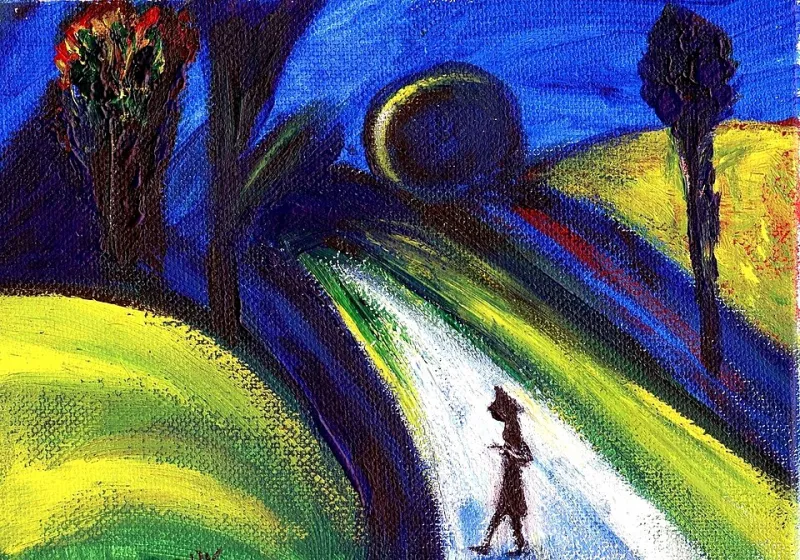
Photo: Hannayana, CC BY-SA 4.0, via Wikimedia Commons
The Camera Is Always On. But Should It Be?
You're mid-session. The melody is coming together, the paint is moving exactly the way you wanted, the words are finally flowing. And then — almost out of reflex — you reach for your phone. You want to capture it. Share it. Prove it happened.
And just like that, the moment is gone.
This isn't a new problem, but it's an urgent one. We live in an era where the documentation of creativity has become almost as valued as creativity itself. Behind-the-scenes reels, studio vlogs, "process content" — all of it has its place. But somewhere along the way, a lot of creators started confusing the record of the work with the work itself. And that confusion is costing them something real.
Call it the presence paradox: the more you try to capture a creative moment, the more you interrupt the very conditions that made it possible.
What Science Says About Flow and the Audience Effect
Psychologists have long studied what happens when people perform or create under observation. The findings are mixed — sometimes an audience energizes you, sometimes it tanks you — but one thread is consistent: self-consciousness is the enemy of flow.
Flow, that deeply absorbed state where time dissolves and the work just happens, requires a kind of ego suspension. You stop monitoring yourself. You stop asking how this looks. You become, for a rare and beautiful stretch of time, purely inside the thing you're making.
The moment you imagine an audience — even a future one, even a hypothetical scroll-past on Instagram — you re-engage your inner critic. You start performing your process instead of living it. And performance, however polished, rarely produces the raw material that moves people.
Singer-songwriter communities have been talking about this for years. There's a reason some of the most beloved albums in American music history were recorded in relative isolation, away from industry eyes and trending sounds. The creative privacy wasn't incidental — it was the point.
The Private Studio as Sacred Space
A growing number of independent artists are making a deliberate choice: keep the creation private, share only the finished piece.
Take the approach that visual artists in cities like Brooklyn and Chicago have started calling "closed studio practice." No process posts, no work-in-progress teasers, no live streams of the creative session. The studio — physical or metaphorical — becomes a sealed environment. What comes out the other side is the only thing the audience ever sees.
One painter described it this way in an interview with an arts journal: "When I know no one is watching, I take risks I wouldn't otherwise take. I let things get ugly. I follow the weird instinct. And that's almost always where the best stuff lives."
Musicians are echoing the same sentiment. Artists who built their followings on raw, intimate content are increasingly pulling back — not because they've lost the desire to connect, but because they've realized that protecting the creative process is actually what makes the connection deeper when it finally arrives.
The finished piece lands differently when it wasn't previewed to death. There's mystery. There's weight. There's something to discover.
Here, Now — Without the Lens
At Mono Is Here, the phrase "be here now" isn't just a tagline. It's a creative philosophy. And it applies directly to this conversation.
Being here now in your creative practice means letting the session be what it is — messy, nonlinear, sometimes completely unproductive — without the pressure of turning it into content. It means trusting that the value of the work isn't diminished because no one witnessed its making.
That's actually a radical idea in 2025. We've been trained to believe that undocumented experiences are somehow less real, less valid. But ask any artist who's had a breakthrough in private and they'll tell you the opposite: those unwitnessed moments are often the most real things they've ever made.
Finding Your Sweet Spot
None of this means you have to disappear entirely. Sharing your work, building community around your creative vision — that's meaningful, and it's a huge part of what makes a creative practice sustainable. The goal isn't silence. It's intentionality.
Here are a few ways artists are striking that balance:
Batch your sharing, not your making. Create freely for a set period — a week, a month — without posting anything. Then share from that body of work deliberately, choosing what actually serves the audience rather than what was easiest to grab in the moment.
Separate your creative space from your content space. Some artists use one room, one notebook, or one device that is strictly off-limits for documentation. The act of entering that space signals to the brain: this is for making, not performing.
Ask why before you hit record. Not every "why" has to be deep, but the habit of pausing before documenting can break the reflex loop. Sometimes you'll decide to share. Sometimes you'll put the phone down and keep going.
Let the finished piece do the talking. Instead of narrating the journey in real time, let the work carry the story. Audiences are often more captivated by a fully realized piece than by a piecemeal behind-the-scenes — especially when the finished product is genuinely surprising.
What You Gain When You Stop Watching Yourself
The artists who've committed to private creation tend to describe the same shift: their work gets stranger, more specific, more theirs. Without the imagined audience shaping every decision, they start making choices that feel true rather than strategic.
And paradoxically? Their audiences feel it. There's a texture to work made without self-consciousness that people respond to even if they can't name it. It's the difference between a song that feels like it was written for you and one that feels like it was written for an algorithm.
Mono Is Here exists in that space — the space between creation and connection, between the private spark and the shared flame. The best creative work often starts in the dark. Give yourself permission to stay there a little longer before you turn on the lights.
The moment will still be real. Maybe more real than anything you've ever posted.